 Renowned researcher Michael Kramer, who has advised the World Health Organization and Unicef, said that he was misquoted after being interviewed regarding supposed benefits of breastmilk.
You may remember the post regarding feminist Joan Wolf, who believes there are very few benefits of breastfeeding, very much in the same style of Hanna Rosin.
In the same Times article, Dr. Michael Kramer was “grossly misrepresented”. He said that the Times completely misquoted him and that he still very much believes in the benefits of breastmilk. He is quite angry at being put on the other side of what he sees as part of his life work. From the Independent:
There really isn’t any controversy about which mode of feeding is more beneficial for the baby and the mother, but when you read the article in The Times it sounds like there is. I’m not aware of any studies that have observed any health benefits of formula feeding. That’s important, and any mother weighing the benefits of breastfeeding vs formula feeding needs to know that.
[social_buttons]
As for the other Times quotes, regarding some breastfeeding benefits he supposedly called “weak”? The McGill researcher was quoted as saying that there was very little evidence to support that breastfeeding is beneficial for anything except a couple of IQ points. But here’s what he actually said,
The existing evidence suggests that breastfeeding may protect against the risk of leukaemia, lymphoma, inflammatory bowel disease, type 1 diabetes, heart disease and blood pressure.
He simply asked that these links be studied further, as any researcher do.es in his field (Like, Dude, give me some money and I’ll look into it!) Furthermore, there is one part of the Times article he especially takes exception to: the IQ point question.
Dr. Kramer has been at the forefront of this issue, including research he and a team did last year that showed that breastfed babies did indeed have a higher IQ. The study focused on long-term (1 year) breastfeeding, and they adjusted for the mothers’ IQ and other factors that often bias studies like this. Plus, the study was randomized and had a huge sample: 14,000 children followed for 6.5 years. So it’s understandable that he’d be mighty frustrated with all the misrepresentations.
There is an IQ advantage to breastfeeding by as much as three or four points. It’s not the difference between Einstein and a mental retard at an individual level, but it means having a smarter population on average, fewer children with school difficulties, and more gifted children.
So yes, those who are anti-breastfeeding (or those who simply like to use the inexplicable term “Breastfeeding Nazi”) can stop dancing on the boob grave. It’s not over. It seems that one of the most respected researchers in this field is, indeed, still on the Breastfeeding Team.
p.s. I’d like to point out that I, too, misrepresented Dr. Kramer by quoting his words from the Times. For that I apologize. (And celebrate his “return”!)
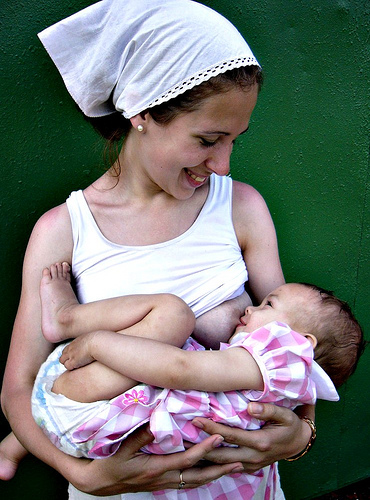
Image: Alexander Tundakov on Flickr under a Creative Commons License. Don’t you love that nursee’s smile?!
Follow me on Twitter. Don’t forget your Breastfeeding Twibbon.
Great post Cate and dang, that is the cutest picture EVER!
I know! I’ve used that pic twice now (once on my other blog) because it’s so great. Right when I saw it I thought of making my 16mo laugh when he’s BFing.
He giggles, but he also *must* keep the nipple in his mouth. This photo always makes me hear his laugh.
The large-scale study performed at McGill that Dr. Kramer was a part of was randomized and did account for factors including socioeconomic status and maternal IQ.
Intelligence does not play a part in why a country is “developed” or not. And it’s slightly xenophobic for you to suggest otherwise.
Please don’t argue on intelligence until you can use proper grammar. Huge pet peeve.
if breastfeeding is so important for intelleigence than why are the most advanced nations the very same that formula feed the most and undeveloped where breast-feeding is the only recourse so intellectually undeveloped? Because most likely neither formula nor breastfeeding effect intelligence: education and parental intelligence are far, far more important. Also, mothers that breastfeed are more likely to do so because they are concerned about such things as their child’s intelligence – in other words, these are parents who make the effort to stimulate their children and care for their health in general. I’m sure where formula and breastfed infants are measured against parental involvement/concern, the results will be equal.
Breastfeeding is gross!
Do you say that because you could not do it?
A mother who is having her second or subsequent child, decides how to feed, based on previous experience. To me, there are 2 good reasons for a mother not to attempt breastfeeding her firstborn. 1- Medical 2- The child is to be adopted.
Other wise , artificial feeding from birth, is like a virgin opting for artificial insemination.